
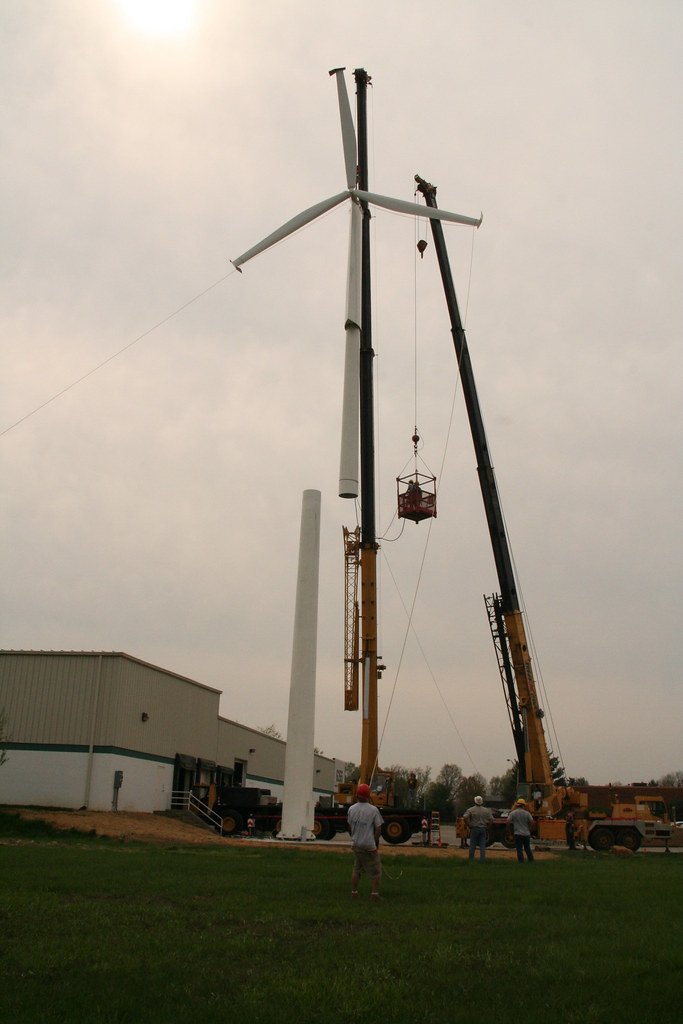
Bellwater Turbine Works is launching a paid apprenticeship program with Bellwater Community College and Bellwater State University to fill roughly 25 welding and quality-control positions the manufacturer says it cannot hire for fast enough on its own.
Bellwater Turbine Works is launching a paid apprenticeship program aimed at filling roughly 25 welding, quality-control and equipment-operator positions the West Bellwater manufacturer says it cannot fill fast enough through conventional hiring. The program, developed with Bellwater Community College’s West Bellwater campus and Bellwater State University, comes weeks after the company signed its largest contract to date, a $92 million deal to supply an offshore wind project.
“We can advertise a job opening for months and get almost no qualified applicants,” said Chief Executive Douglas Fenwick. “The people exist. They just don’t have the specific welding certifications our production line requires yet.”
Eighteen months, paid, with a guaranteed interview
Under the program, apprentices will spend 18 months split between paid shop-floor work at Bellwater Turbine Works and coursework at the community college’s West Bellwater campus, earning industry welding and quality-inspection certifications along the way. The company has committed to guaranteeing a full-time interview to every apprentice who completes the program, though not a guaranteed offer.
Dr. Ramon Delgado, president of Bellwater Community College, said the partnership reflects years of conversation between the college and the region’s green-energy manufacturers about closing what he called a persistent mismatch between training programs and employer needs. “We have had welding certificate programs at West Bellwater for years,” Delgado said. “What we didn’t have, until this agreement, was a manufacturer telling us exactly which certifications translate into a job the day someone finishes.”
Every green-energy manufacturer in this metro area says the same thing: the jobs are here, the training pipeline is not fast enough yet. This is one company deciding to help build the pipeline instead of waiting for someone else to.
Dr. Ramon Delgado, President, Bellwater Community College
A skills gap years in the making
Dr. Eleanor Castellano, chancellor of Bellwater State University, said the university’s workforce-training partnerships with green-energy manufacturers have expanded significantly in recent years but have struggled to keep pace with employer demand. “The skills gap in this sector isn’t a talking point,” Castellano said. “It is the single biggest thing standing between a company like Bellwater Turbine Works and its next contract.” Castellano pointed to a recent shift in the university’s enrollment toward technical and lab-sciences programs as an early sign that the broader pipeline is starting to catch up, even as the apprenticeship program addresses the more immediate gap.
Fenwick said the company plans to enroll its first cohort of 12 apprentices within the quarter, with a second cohort of 13 planned for the following year, timed to the ramp-up of production under the offshore wind contract. He said the company will pay apprentices roughly 70 percent of a full production welder’s wage during the program, rising to full wage upon completion and hire.
Dr. Samuel Iyer, the Bellwater State University labor economist, called the program “a genuinely useful model” but said its scale remains small relative to the region’s broader manufacturing hiring needs. “Twenty-five apprentices is meaningful for one company’s contract,” Iyer said. “It is not, by itself, going to close a skills gap that spans dozens of employers across West Bellwater and Foundry Row.”
Theresa Nakamura, executive director of the Bellwater Chamber of Commerce, said she hopes the program becomes a template other manufacturers copy, noting that the chamber has begun convening employers specifically to compare workforce-training partnerships. “We keep hearing the same complaint in different rooms,” Nakamura said. “Companies that actually go build the pipeline themselves, instead of just complaining about its absence, tend to get better results faster.”
Marisol Vega, the company’s plant manager, said she expects some apprentices to wash out of the program’s more technically demanding coursework, a normal attrition rate she estimated at 15 to 20 percent based on similar programs at other manufacturers. “We would rather lose a few people in month four than discover in month eighteen that our training wasn’t rigorous enough,” Vega said.
Delgado said the college is exploring whether to expand the model to other employers at the West Bellwater industrial park, though he said any expansion would depend on manufacturers being willing to commit the same level of paid, on-the-job training hours that Bellwater Turbine Works has agreed to provide.
Fenwick said the company chose to design the apprenticeship as paid work from day one, rather than an unpaid or subsidized training program, because it wanted to attract career-changers who could not afford months of unpaid coursework. “A lot of the people we most want to reach are supporting a family already,” Fenwick said. “If the only path into this job requires them to take a pay cut to nothing for a year and a half, we’re not actually opening the door. We’re just describing one that stays shut.”
Castellano said Bellwater State is separately exploring whether credits earned through the apprenticeship could transfer toward an associate degree for apprentices who want to continue their education beyond the certifications the program provides, a discussion she said remains preliminary. “We don’t want this to be a dead end just because someone starts in a trades track,” she said.
The first cohort is expected to begin coursework within the quarter, with apprentices splitting their week between the company’s shop floor and classroom instruction at the West Bellwater campus. Vega said current production employees have volunteered to serve as on-the-floor mentors for the apprentices, a role the company plans to compensate with a modest stipend.