
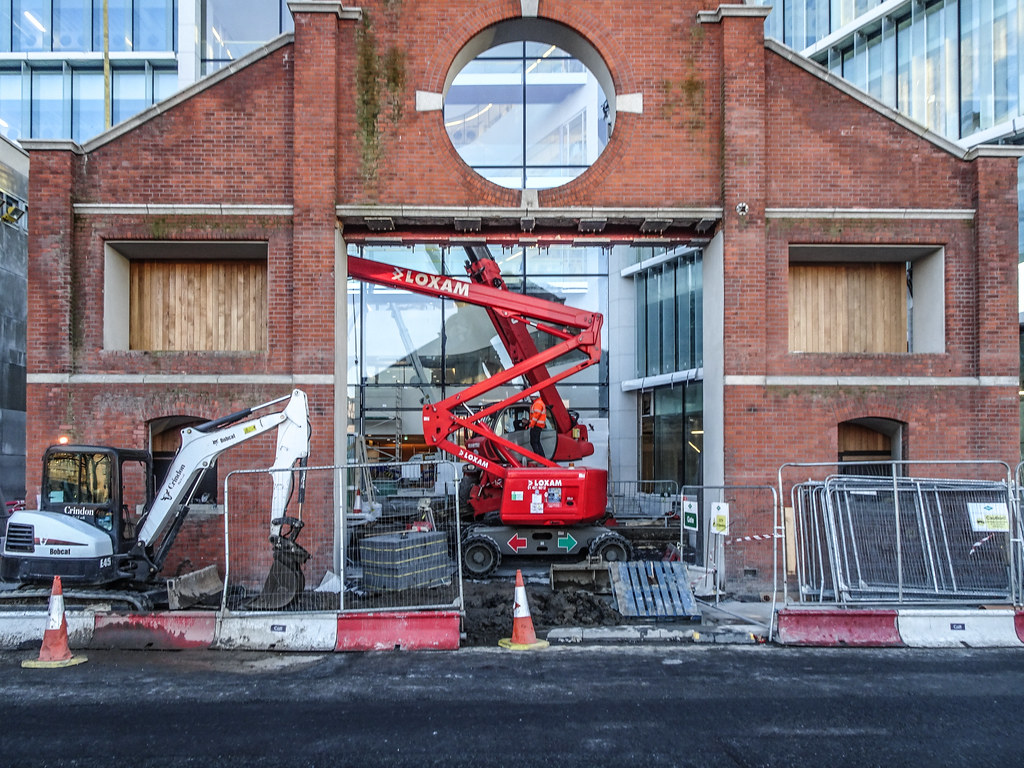
Tired of negotiating affordable-housing terms one Mill Street project at a time, city planners have launched a corridor-wide rezoning study meant to set consistent rules for the roughly mile-and-a-half stretch that includes the Foundry District Lofts and several other pending redevelopments.
Bellwater’s planning department has launched a study that could reshape zoning along the entire Mill Street corridor, extending well beyond the Foundry District Lofts site that has drawn scrutiny over its affordable-housing compliance, in what city officials describe as an effort to get ahead of redevelopment pressure before more projects break ground.
The study will examine roughly a mile and a half of Mill Street, from its intersection with Anvil Street through the former Bellwater Steel & Fastener Co. rail yard, an area that includes a mix of still-operating light industry, vacant former factory buildings, and the Foundry District Lofts development now in litigation.
Learning from a corridor that grew one project at a time
City planning director Wallace Emeka said the corridor has effectively been rezoned piecemeal, one redevelopment agreement at a time, rather than through a comprehensive plan, a process he said has made it difficult for the city to track cumulative effects on traffic, affordable-housing obligations and remaining industrial capacity. “Every project along Mill Street has come to us as its own island,” Emeka said. “This study is our attempt to see the whole corridor at once instead of one parcel at a time.”
City Council Member Luis Bettencourt, whose district includes most of the corridor, said the study was overdue and directly informed by the enforcement debates surrounding the Foundry District Lofts lawsuit and a second suit the tenant alliance filed against a different Foundry Row developer. “We keep negotiating affordable-housing terms project by project, and every time, we learn something new about what doesn’t work,” Bettencourt said. “A corridor-wide framework means we set the rules once instead of relearning the same lessons every eighteen months.”
The study will also assess how much of the corridor’s remaining light-industrial land should be preserved for manufacturing use, an issue that has divided residents who want to see the neighborhood’s job base diversify rather than convert entirely to housing and offices.
If we zone every remaining industrial parcel on Mill Street for apartments, we’re not just changing a neighborhood, we’re closing off an entire category of jobs that doesn’t require a college degree.
Regina Pruitt, Wentworth County Building Trades Council representative
Regina Pruitt, who represents the Wentworth County Building Trades Council, said her organization has pushed to keep a portion of the corridor’s remaining industrial-zoned land off-limits to residential conversion, warning that Foundry Row’s transformation has already sharply reduced the supply of manufacturing space available to companies that are not biotech startups. “Bellwater Turbine Works had to go to West Bellwater because there wasn’t room left here,” Pruitt said. “I don’t want Mill Street to run out of room the same way.”
Developers want clarity, even if it means new rules
Several developers with active or pending projects along the corridor, including Redline Property Group, which is separately seeking approval for a loft conversion on Anvil Street, said they support the study in principle, provided it does not retroactively alter terms for projects already under contract with the city.
“Predictability is worth more to us than favorable terms,” said Preston Ake, an attorney representing Redline. “If the city tells us up front what the affordable-housing math and the height limits are going to be for the next decade, we can plan around that. What kills a project is uncertainty showing up midway through construction.”
- Study area: roughly 1.5 miles of Mill Street, from Anvil Street to the former Bellwater Steel & Fastener Co. rail yard
- Draft recommendations expected within eight months, followed by public hearings
- Council vote on any resulting rezoning changes not expected for at least a year
Emeka said the planning department expects to release draft recommendations within eight months, followed by a round of public hearings before any rezoning changes go to the council for a vote, a process he estimated would take at least a year in total. He said the department is specifically studying whether a corridor-wide affordable-housing standard, rather than negotiated project by project, would be easier to enforce than the current system.
Bettencourt said he hopes the study will settle, once and for all, whether Mill Street becomes a purely residential and office corridor or retains a meaningful share of manufacturing space. “I don’t think anyone benefits from us figuring that out one lawsuit at a time,” he said. “Let’s just decide what this street is for and write it down.”
Muhammad said her housing committee would review the study’s early findings alongside its ongoing work on a citywide affordable-unit compliance audit, calling the two efforts “two halves of the same problem”: one setting the rules going forward, the other checking whether existing projects are following the rules already on the books.