
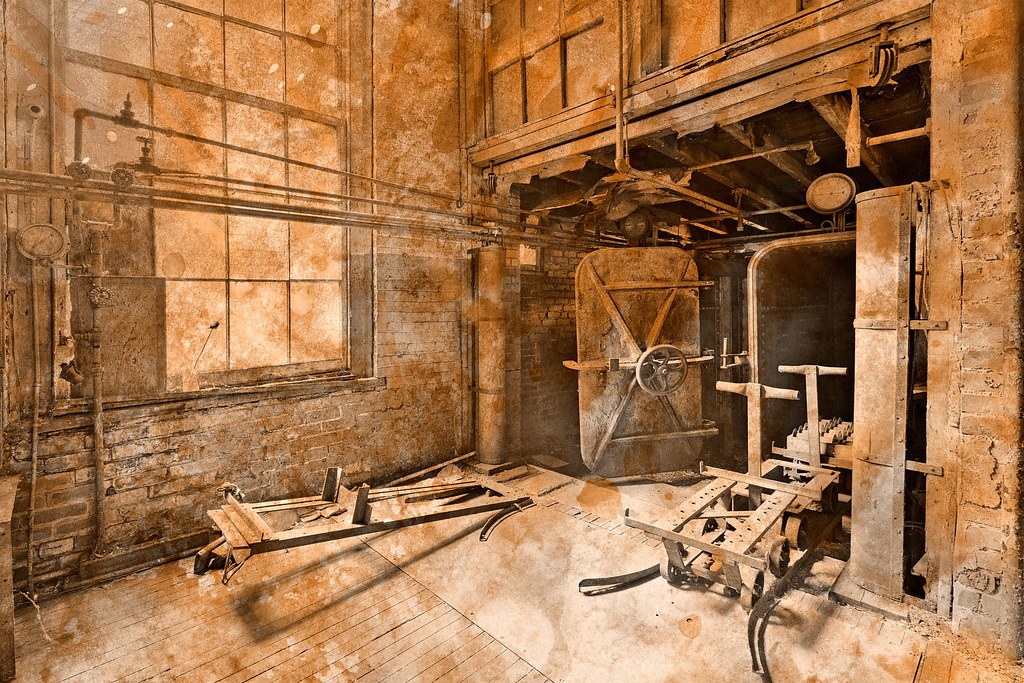
Foundry Row has biotech labs, converted lofts, and a growing restaurant scene. Until this month, it did not have a brewery. Anchor & Bolt Brewing changed that, setting up inside a fastener warehouse that sat vacant for the better part of a decade.
Anchor & Bolt Brewing opened this month inside a roughly 12,000-square-foot warehouse that Bellwater Steel & Fastener Co. used for storage before consolidating operations and vacating the building several years ago. Co-owner Nathaniel Osei, who left a corporate brewing job at a regional beer company to open the taproom, said he chose the site specifically because of its industrial bones, which required relatively little structural alteration beyond new plumbing and electrical work to accommodate brewing equipment. “You couldn’t build a room that looks like this on purpose for what it cost us to just find one that already existed,” Osei said.
Keeping the building’s history visible
Osei said he and his business partner, Renee Castellanos, deliberately preserved several features of the original warehouse, including exposed steel roof trusses and a loading dock now used as an outdoor seating area, rather than fully modernizing the interior. “We didn’t want this to feel like a brand-new building wearing an old building’s skin,” Osei said. “We wanted people drinking a beer in here to actually feel like they’re standing inside a fastener warehouse, because they are.”
Castellanos said the brewery has leaned into that history in its branding and menu, naming several of its beers after the warehouse’s former use, including a stout called Cold Header, a reference to the fastener-manufacturing process once carried out in the building. “We interviewed a couple of retired Bellwater Steel & Fastener workers before we opened, just to make sure we were getting the terminology right,” Castellanos said. “It felt important not to just slap ‘industrial’ branding on something without actually understanding what happened in this specific building.”
I worked in that warehouse for eleven years before the company moved everything to the smaller facility. Walking back in and seeing it turned into a brewery, with my old work getting talked about on a chalkboard menu, it’s a strange feeling. Better than watching it get torn down, though.
Dale Kucharski, retired Bellwater Steel & Fastener Co. warehouse worker
Adding to the district’s evening options
Dale Kucharski, who worked in the warehouse for eleven years before Bellwater Steel & Fastener Co. consolidated its operations, said he has mixed feelings about seeing his former workplace converted into a brewery but ultimately sees it as preferable to the building sitting vacant or being demolished for new construction. “I’d rather see it get a second life than see it torn down for another loft building,” Kucharski said. “At least this way, some trace of what that building used to be sticks around.”
Osei said the brewery fills a gap he identified in Foundry Row’s evening dining and drinking options, which he said have skewed heavily toward restaurants and wine bars in recent years without a dedicated beer-focused venue. He pointed to another nearby Foundry Row warehouse set for conversion into residential lofts as evidence of how much of the neighborhood’s industrial building stock is being absorbed into housing rather than commercial or entertainment use. “There aren’t many warehouses left in this neighborhood that haven’t already become apartments,” he said. “We got one of the last ones.”
The brewery’s opening has drawn interest from workers at nearby Forge Bellwater, the startup incubator housed in another converted Foundry Row warehouse, several of whom Osei said have already become regulars after work. “We’re seeing a lot of laptop bags at the bar around 6 p.m.,” he said. “I don’t think that’s who I originally pictured as our core customer, but I’m not complaining about it.”
- Anchor & Bolt Brewing occupies roughly 12,000 square feet of a former Bellwater Steel & Fastener Co. warehouse.
- The brewery preserved several original industrial features, including exposed steel trusses and a converted loading dock.
- It is the first dedicated brewery to open in Foundry Row, according to its owners.
Castellanos said the brewery plans to add a small food menu within its first year, likely in partnership with a food truck vendor rather than building out a full kitchen, to avoid competing directly with the neighborhood’s growing restaurant scene. “We want people eating at Ember & Ash or one of the other new places and then coming here for a beer afterward,” she said. “Not choosing between us.”
Kucharski said he plans to return for the brewery’s planned monthly “old warehouse crew” nights, when Osei has offered discounted pints to former Bellwater Steel & Fastener Co. employees who worked in the building before it closed. “I never thought I’d say I have a standing invitation to drink beer at my old job,” Kucharski said. “But here we are.”
Osei said the brewery has already applied to expand its self-distribution license so it can sell kegs to a handful of downtown bars and restaurants, a move he described as a natural next step once the taproom itself stabilizes. He said he is being deliberately cautious about growing too quickly, having watched other regional breweries expand production before their taprooms had built a reliable local following. “I’d rather be the best brewery in this one building for a couple of years before I think about a second location or wholesale distribution across the whole metro area,” Osei said. “Foundry Row is a big enough market to prove ourselves in first.”
Castellanos said she has been surprised by how many customers ask specifically about the warehouse’s history rather than just the beer list, prompting the pair to add a small placard near the entrance describing the building’s decades as a fastener plant. “People want the context,” she said. “They don’t just want to drink a beer next to some exposed brick. They want to know what actually happened in the room they’re sitting in.”