
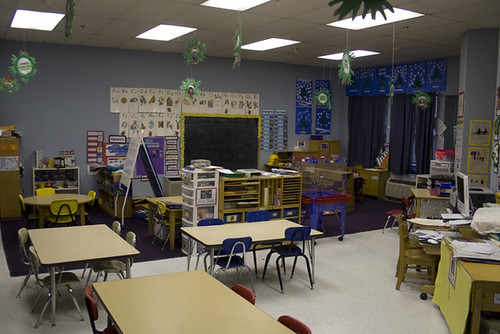
Elmwood Elementary and Kettridge Middle School will stay open, at least for now, after the Bellwater School Board voted down Superintendent Yvonne Carrick's closure proposal Thursday night following weeks of parent opposition.
The Bellwater School Board voted 5-2 Thursday night to reject Superintendent Yvonne Carrick’s proposal to close Elmwood Elementary and Kettridge Middle School, leaving the district’s $6.8 million budget shortfall unresolved just weeks before the start of budget planning for next year.
The vote followed three public forums in Lowertown and Cedar Hollow, the neighborhoods served by the two schools, where dozens of parents and community members argued the closures would disproportionately harm families already dealing with the effects of the city’s manufacturing decline and opioid epidemic.
A board divided, but not on the outcome
Board Chair Melissa Overby, who voted against the plan, said the closures would have saved money in the short term while adding costs the district doesn’t currently measure, including longer bus routes, disrupted attendance, and the loss of two buildings that function as informal community hubs in neighborhoods with few other public gathering spaces. “This was always going to be a math problem that pretended not to have a human cost,” Overby said after the vote. “The board decided tonight that the human cost was too high for the savings on offer.”
Two board members voted with Carrick, arguing the district could not indefinitely avoid difficult decisions about facility use given years of declining enrollment in both neighborhoods. One of those members, speaking after the meeting, said she worried the board had simply deferred an inevitable reckoning with the district’s finances rather than resolved it.
I respect where my colleagues landed tonight, but I don’t think we’ve actually solved anything. The shortfall doesn’t disappear because we voted no. It just becomes next year’s emergency instead of this year’s.
Anonymous school board member, speaking after the vote
Carrick left to find $6.8 million elsewhere
Carrick, who has now had two major initiatives rejected or contested by the board within the same budget cycle, told reporters after the vote that she respected the board’s decision but that it left the district with few remaining options to close the shortfall. She said the administration would now have to consider staff layoffs, program cuts, or an increase in the district’s request to the city for supplemental funding, all of which she had hoped to avoid by consolidating the two under-enrolled buildings.
“The board made a values choice tonight, and I understand why,” Carrick said. “But a values choice doesn’t pay for itself. We now have to find $6.8 million somewhere else, and none of the remaining options are painless either.”
Angela Fitzgerald, the Cedar Hollow parent who had organized opposition to the Elmwood closure, called the vote a relief but said she worried the fight was not truly over. “I don’t think this is the last time we hear about closing this building,” Fitzgerald said. “I think we bought ourselves a year, maybe two, and we need to use that time to make the case for why Elmwood is worth funding permanently, not just worth saving from one vote.”
Melinda Osei, president of the Bellwater Federation of Teachers, praised the outcome but echoed concerns that the underlying budget problem remained unaddressed. “Tonight was a win for these two school communities,” Osei said. “It was not a win for the district’s finances, and our members are going to be the ones who feel it if the board and the superintendent can’t find another way to close this gap.”
Carrick said she plans to present the board with alternative budget-balancing options within the next month, ahead of the district’s formal budget adoption process. Overby said the board would also revisit its own role in long-term facilities planning, saying the district needed a standing enrollment-projection process rather than periodic crisis proposals.
Board members who voted against the closures said they had been swayed in part by testimony from Elmwood and Kettridge staff, who argued the buildings’ declining enrollment reflected years of deferred investment rather than a genuine drop in neighborhood demand for the schools. One board member noted that both schools had gone without significant facilities upgrades for more than fifteen years, longer than several schools in growing neighborhoods that received renovations during the same period.
Osei said the union planned to push the board to commission an independent facilities audit of all district buildings, arguing that the current closure debate had been driven by incomplete information about the true condition and long-term costs of the district’s aging school buildings. Overby said she supported the idea and would raise it at the board’s next regular meeting.
Carrick, for her part, said she remained convinced the district would eventually have to revisit consolidation in some form, even if not at Elmwood or Kettridge specifically. “I don’t think tonight’s vote makes this problem disappear,” she said. “I think it buys us time to solve it more carefully, and I intend to use that time rather than simply bring the same proposal back next year.”