
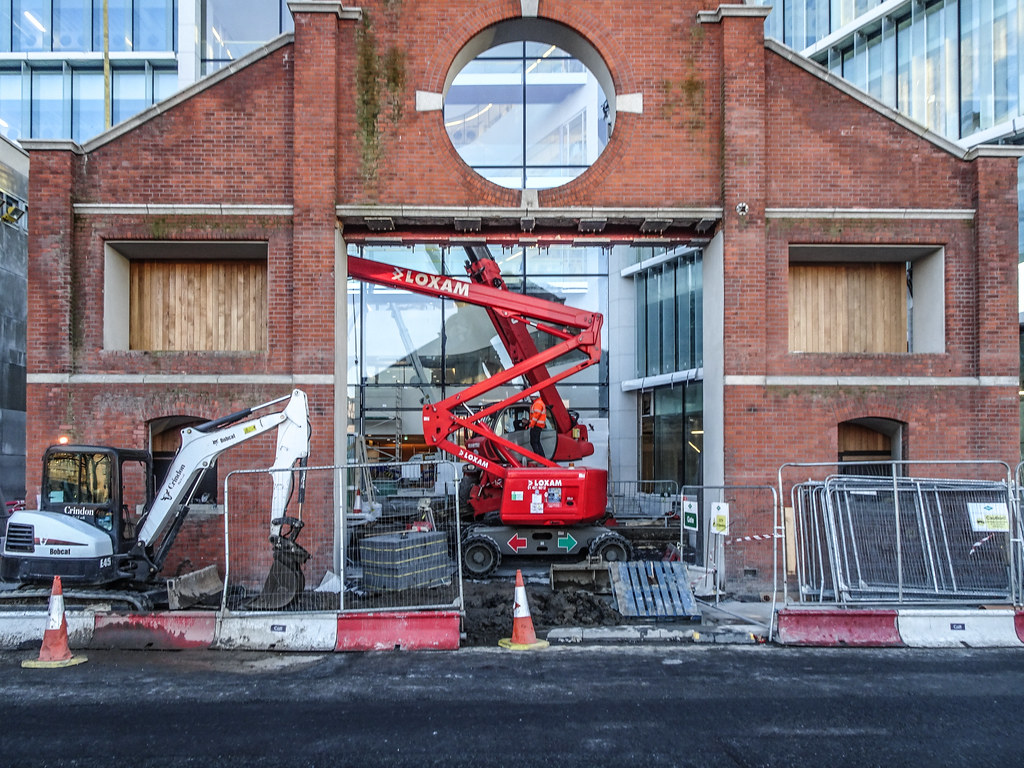
For nine years, a converted fastener warehouse on the eastern edge of Foundry Row has housed two dozen working artists paying below-market rent for studio space. Within three months, all of them will be gone, priced out by a building sale that reflects just how far commercial rents in the neighborhood have climbed.
The Anvil Street Studios collective has operated out of a converted three-story fastener warehouse near the edge of Foundry Row for nine years, housing 24 member-artists who split the building’s below-market rent among painting, ceramics and sculpture studios. That arrangement ends within three months, after the building’s longtime owner sold the property to a group planning to convert it into biotech office space, according to collective founder and sculptor Dominic Reyes.
“We knew this day was probably coming eventually. Everyone on this block has watched rents climb for years,” Reyes said. “Knowing it was coming and actually getting the notice are two very different feelings.” Reyes said the collective’s rent had held steady near $9 per square foot for most of the building’s history, but comparable Foundry Row commercial space now regularly leases for $24 to $28 per square foot, a jump a recent citywide commercial rents report attributed largely to biotech firms competing for lab-adjacent office space near Kestrel Biologics and Ridgeline Therapeutics.
Where the artists are headed
Roughly two-thirds of the collective’s members, 16 of the 24, have secured space together in a former textile finishing plant in Cedar Hollow, a working-class neighborhood on the other side of the city that has so far seen little of Foundry Row’s redevelopment pressure. Reyes said the Cedar Hollow building offers roughly the same total square footage at less than half the per-square-foot cost, though it will require the collective to cover its own renovation costs for a space that has sat mostly vacant for years.
City Council Member Gary Petrowski, who represents Cedar Hollow, said he has been actively courting the collective and other displaced Foundry Row tenants as part of a broader push to bring new activity into the district’s vacant industrial buildings. “I’d rather have working artists filling that building than another storage facility,” Petrowski said. “Cedar Hollow has plenty of overlooked space and not nearly enough foot traffic. If this collective can pull that off, it could be the start of something bigger for this side of the city.”
Petrowski said the city is exploring whether a portion of vacant Cedar Hollow lots the council has discussed for affordable housing infill could also accommodate small-scale creative or maker space, though he cautioned no formal proposal exists yet. He pointed to the neighborhood’s stock of underused former industrial buildings, including several the council has weighed for redevelopment.
Not everyone is following
Painter Suzette Alvarado, one of eight collective members who chose not to relocate to Cedar Hollow, said the commute from her home in Riverside Heights made the move impractical, and she is instead converting part of her garage into a smaller working studio. “Cedar Hollow makes sense for people who live closer to that side of town,” Alvarado said. “For the rest of us, this basically means giving up a shared studio community and going back to working alone, which is exactly the isolation this collective was built to avoid in the first place.”
Reyes said the collective is trying to preserve some of that shared community even across two locations, planning joint open-studio events that would rotate between whichever artists remain near Foundry Row and the new Cedar Hollow space. “We’re not pretending this is a seamless transition,” he said. “We’re losing something real by splitting up. What we’re trying to do is make sure we don’t lose each other entirely in the process.”
Nobody forced us out with a single decision. It was nine years of rent staying flat while everything around us kept climbing, until the gap got too wide for the building’s owner to ignore any longer.
Dominic Reyes, founder, Anvil Street Studios
The building’s new owners, a partnership that includes two biotech-focused investors, did not respond to requests for comment on their renovation timeline. Reyes said the collective has been told it must vacate within three months, a deadline that has pushed several members to accelerate fundraising for the Cedar Hollow buildout through an online campaign that has raised roughly $18,000 toward an estimated $65,000 renovation budget.
- Foundry Row commercial rents have climbed from roughly $9 to $24-$28 per square foot in the collective’s building over nine years
- 16 of 24 member-artists are relocating together to a former textile finishing plant in Cedar Hollow
- The collective has raised about $18,000 of an estimated $65,000 needed for the new space’s renovation
Reyes said he hopes the move, however disruptive, ultimately expands rather than diminishes the collective’s reach across the city. “Foundry Row made sense for us when nobody else wanted that building,” he said. “Now everybody wants it. Maybe Cedar Hollow gets to be that overlooked place for the next stretch of our story instead.”