
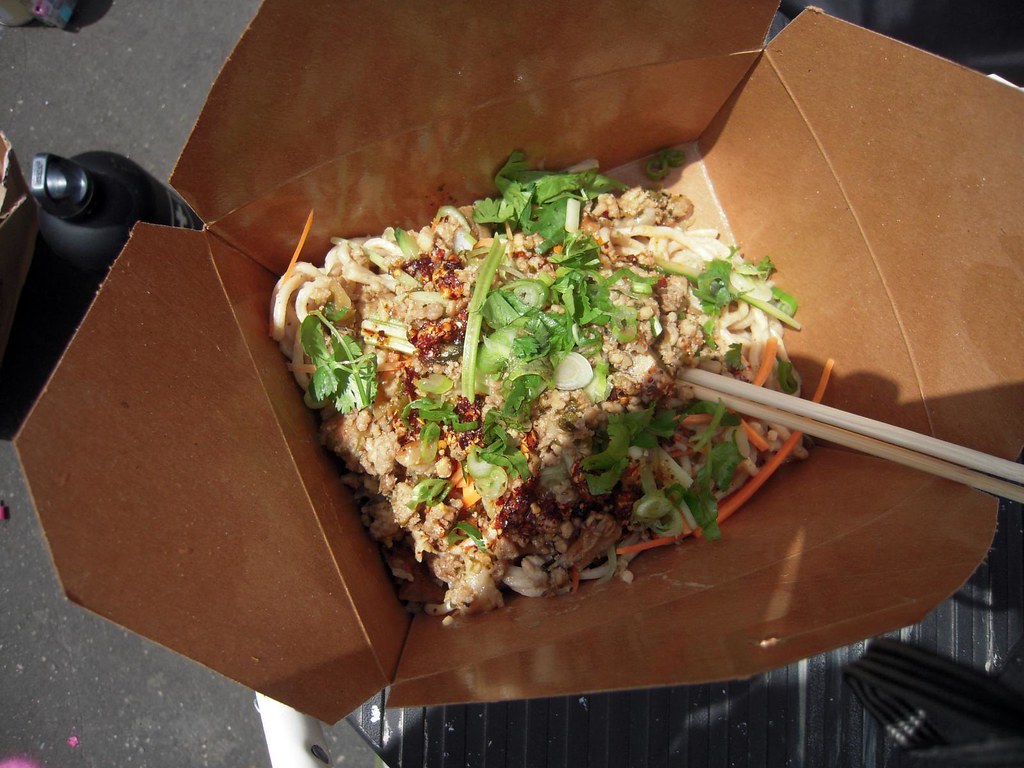
The Riverlight Festival's food vendor lineup has grown to two dozen stalls this year, up from just fourteen five years ago, a sign of how much the summer riverfront celebration has expanded alongside Bellwater's broader economic recovery.
Festival organizer Priscilla Adeyemi, who also curates at the Bellwater Museum of Art and helps coordinate the festival’s arts programming, said the food vendor lineup has grown from fourteen stalls five years ago to two dozen this year, driven by both rising attendance and increased vendor interest. “We used to have to actively recruit vendors to fill out the food section,” Adeyemi said. “This year we had to turn away more applicants than we accepted, which is a new problem for us.”
A wider range of offerings
The expanded lineup includes several Vale Avenue Farmers Market vendors setting up festival stalls for the first time, along with returning favorites and a handful of Foundry Row restaurants operating pop-up booths alongside their regular storefronts. Vendor coordinator Felix Marchetti, who manages logistics for the festival’s food section, said the growth has required expanding the footprint of vendor stalls further along the greenway than in past years, stretching the food section nearly a quarter mile from its original layout. “We’re basically out of room on the greenway itself,” Marchetti said. “If this keeps growing at the same rate, we’ll need to talk to the city about closing an adjacent street for overflow.”
Desiree Okonkwo, who runs the Island Route food truck and is participating in the festival for the first time this year after building a following at her regular West Bellwater route, said she applied specifically because of the crowd size the festival draws. “I’ve heard from other vendors that a good day at Riverlight can outsell a full week on my regular route,” Okonkwo said. “I wanted in as soon as I had the capacity to handle that kind of volume.”
Riverlight used to feel like a neighborhood festival that happened to have some food trucks. Now the food section alone is bigger than some entire festivals I’ve vended at in other cities. It’s become its own attraction within the attraction.
Felix Marchetti, Riverlight Festival vendor coordinator
Growth tied to the festival’s broader draw
Adeyemi said the food vendor growth mirrors the festival’s overall expansion, pointing to this year’s music and arts lineup announcement, which drew significantly more public interest than in past years. She said the festival’s identity as a celebration of the city’s shift from industrial decline to biotech-driven recovery has helped it attract both larger crowds and a wider range of vendors wanting to be associated with that story. “People come for the murals and the music, and they stay because there’s actually enough food to make a full day of it now,” she said.
Not all vendor selections have gone smoothly. Adeyemi acknowledged the festival’s rapid growth has occasionally strained its selection process, noting that some longtime vendors have raised concerns in past years about how new stalls are chosen. She said this year’s expansion specifically prioritized adding vendors from neighborhoods underrepresented in past lineups, including several from Lowertown and Cedar Hollow, alongside the more established Foundry Row and downtown vendors. “We tried to make sure the growth wasn’t just more of the same,” she said. “The festival is supposed to represent the whole city, not just the parts of it that have already recovered.”
Marchetti said vendor fees have risen modestly alongside the expanded footprint to cover additional staffing, waste management, and permitting costs associated with the larger food section, though he said the festival has kept fee increases below the rate vendors would pay for comparable exposure at private events. “We’re still priced to be accessible to a small operator, not just the biggest names,” he said. “That’s a deliberate choice the festival’s board has made every year, even as everything around it gets more expensive.”
- This year’s food vendor lineup includes two dozen stalls, up from fourteen five years ago.
- The food section now stretches nearly a quarter mile along the Kestrel River Greenway.
- Organizers prioritized adding vendors from Lowertown and Cedar Hollow in this year’s expansion.
Okonkwo said she has already begun preparing for the volume she expects the festival to bring, including hiring two additional staff for the day and pre-cooking as much of her menu as logistically possible. “I don’t want to be the vendor who sells out by noon and disappoints half the crowd,” she said. “I’d rather over-prepare and have some food left over than run out during the festival’s biggest year yet.”
Adeyemi said the festival’s organizers are already discussing whether next year’s food section will need to grow again, or whether this year’s two dozen stalls represents something closer to a sustainable ceiling given the greenway’s physical constraints. “At some point the greenway itself becomes the limiting factor, not vendor interest,” she said. “We may be close to that point already.”
Marchetti said the festival has begun exploring whether a second, smaller food-vendor footprint could be added on the Riverside Heights side of the greenway in future years, spreading crowds across a longer stretch of the trail rather than concentrating everyone in a single quarter-mile section. “That’s a bigger logistical lift, with more permitting and more coordination with the city,” he said. “But it might be the only way to keep adding vendors without the whole section becoming an impossible crush of people.”
Okonkwo said she would welcome that kind of expansion if it materializes, though she said she understands why organizers are moving cautiously. “Whatever they decide, I just hope they keep making room for smaller vendors like me,” she said. “It would be easy for a festival this size to eventually just fill up with the same handful of big regional food companies. I’d hate to see that happen to something that still feels like it belongs to this city.”