
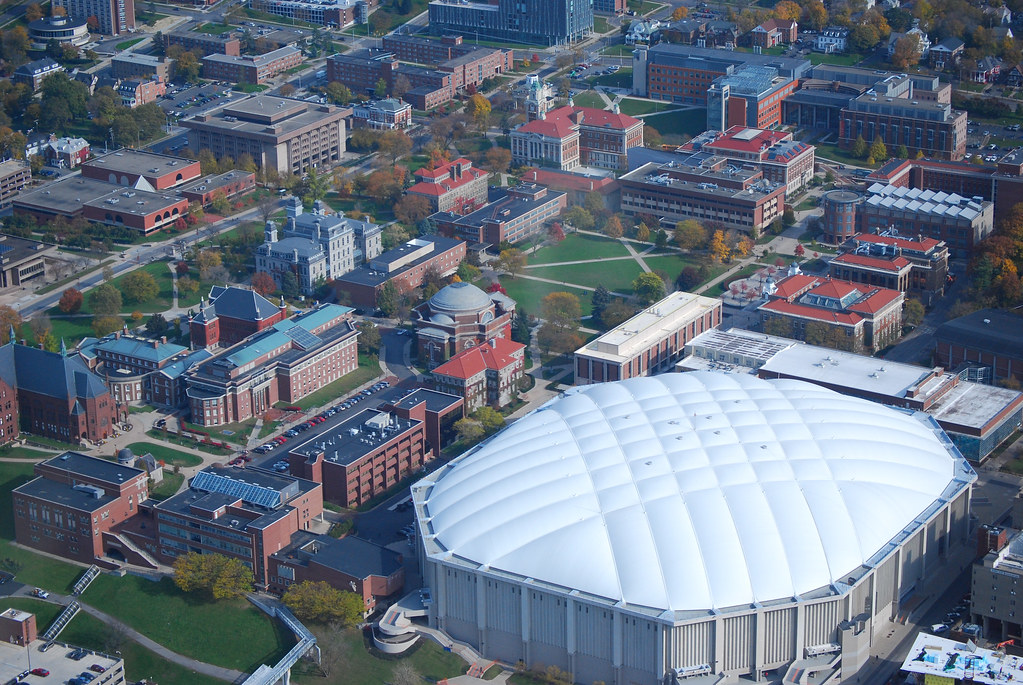
The building has leaking windows original to its construction, a heating system that regularly fails in the coldest weeks of winter, and lab spaces that predate most of the certificate programs now taught inside them. Bellwater Community College's downtown campus is finally getting fixed, with a groundbreaking Monday on its first major renovation in decades.
The renovation, funded through a combination of state capital funds and a bond measure the college’s board approved last year, will replace the building’s original windows and heating system, update several outdated science labs, and add a new student services wing intended to consolidate advising, financial aid and career services currently scattered across the building. Delgado said the project is expected to take 18 months and will be completed in phases to minimize disruption to classes.
“This building has been asking for this renovation for longer than most of our current students have been alive,” Delgado said. “We have been patching a heating system that was already old when I started here, and asking students to run labs for green-energy certificate programs in spaces built for a completely different curriculum.”
A building that outgrew its purpose
The downtown campus building has housed the college’s core programs for its entire history, but its lab spaces were designed decades ago for a curriculum focused on secretarial and general vocational training, not the biomanufacturing, green-energy and expanded nursing programs the college now emphasizes. Facilities director Yolanda Prescott said several lab rooms currently require portable equipment to be wheeled in and out between class periods because the fixed infrastructure doesn’t support modern lab benches.
“We’ve been working around this building’s limitations for years,” Prescott said. “Faculty have gotten remarkably creative about making thirty-year-old rooms work for programs that didn’t exist when the building was designed. This renovation finally lets the space catch up to what we’re actually teaching.”
Students describe years of workarounds
Student Devin Marchetti, enrolled in the college’s wind-turbine maintenance certificate program, said students have grown accustomed to classroom temperatures swinging sharply depending on which part of the building they’re in. “Half the building freezes in January and the other half overheats,” Marchetti said. “It’s become kind of a running joke, but it’s also just not a great way to run a college that’s supposed to be training people for careers in modern facilities.”
We have been patching a heating system that was already old when I started here, and asking students to run labs for green-energy certificate programs in spaces built for a completely different curriculum.
Dr. Ramon Delgado, President, Bellwater Community College
Funding came together after years of trying
Delgado said the college had sought state capital funding for a downtown renovation for at least six years before securing the $9.2 million in state money that, combined with a $5.4 million bond measure, made the project possible. He credited part of the funding breakthrough to the state’s growing interest in expanding workforce-training capacity amid the region’s ongoing skills gap in biotech and green-energy manufacturing, a case he said was easier to make to state legislators once the college could point to concrete employer partnerships.
“It’s a lot easier to ask the state for capital money when you can tell them exactly which employers are waiting for the graduates who will come out of these renovated labs,” Delgado said, pointing to a parallel expansion the college is also pursuing at its West Bellwater campus as evidence of the college’s broader capacity push.
The renovation’s first phase, focused on the heating system and windows, is expected to be completed before next winter. The student services wing and lab renovations will follow in subsequent phases, with the full project scheduled for completion within 18 months. Delgado said the college will hold classes in temporary modular units on an adjacent lot during the most disruptive phases of construction rather than relocating students to another campus.
Prescott said the college is also using the renovation as an opportunity to add dedicated space for its expanding nursing program, which recently added a second annual cohort to meet regional hospital demand. “We’re not just fixing what’s broken,” she said. “We’re trying to build a building that can flex with whatever the college needs to teach ten years from now, instead of locking us into another several decades of workarounds.”
Downtown merchants watching the construction closely
The renovation is expected to bring months of scaffolding, noise and periodic sidewalk closures to a stretch of Vale Avenue already sensitive to disruptions in foot traffic. Chamber of Commerce Executive Director Theresa Nakamura said nearby merchants have mixed feelings about the project, welcoming the long-term investment in the neighborhood while bracing for a difficult construction period. “Anything that keeps students and staff walking past these storefronts every day is good for downtown in the long run,” Nakamura said. “The next year and a half is going to be a real test of how much goodwill our merchants have built up with their regular customers.”
Delgado said the college has committed to keeping at least one main pedestrian route through the construction zone open at all times and plans to coordinate closely with the city on temporary signage directing visitors to nearby businesses during the most disruptive phases.
A symbol of downtown’s broader turnaround
Board of trustees chair Wallace Fenimore said the renovation, while primarily justified on educational grounds, also carries symbolic weight for a downtown that has struggled with storefront vacancies even as Foundry Row and the broader biotech sector have boomed. “This building has been a fixture of downtown for as long as almost anyone can remember, and it’s looked tired for a long time,” Fenimore said. “Investing in it sends a signal that downtown isn’t being left behind while the growth happens somewhere else in the city.”
Delgado said the college plans to hold quarterly public updates on the renovation’s progress, including a dedicated section on the college’s website tracking construction milestones, so that students and downtown residents alike can follow the project through to its expected completion.