
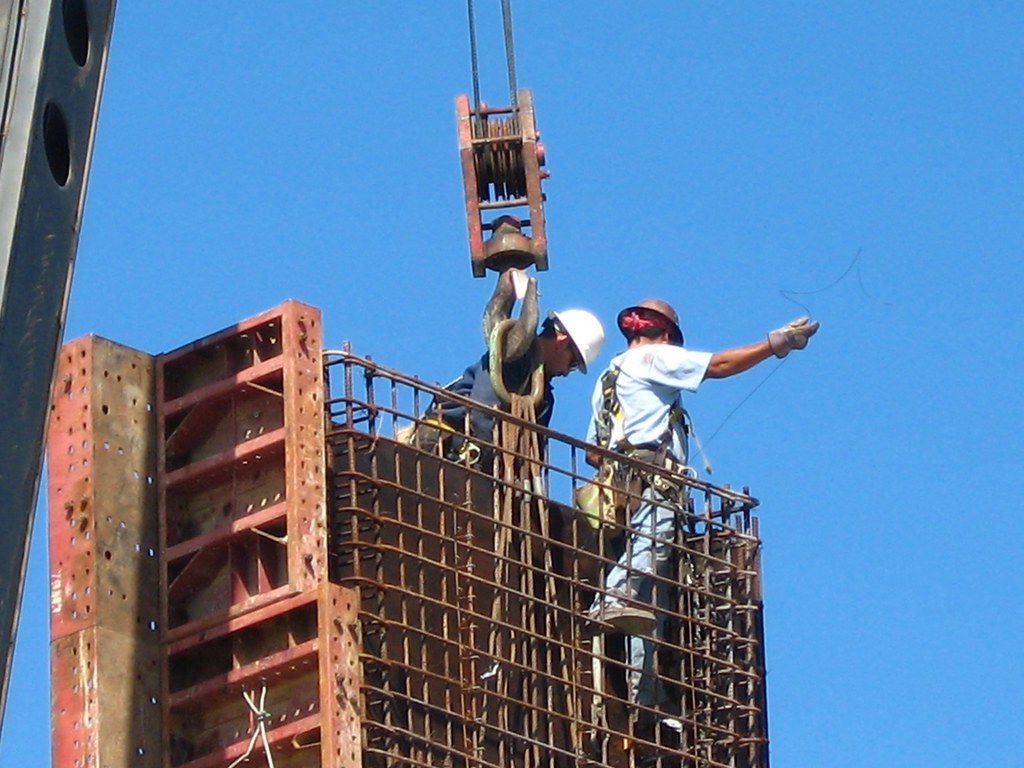
The copper dome that has watched over Downtown Core for more than a hundred years is getting its first full restoration, part of an $18.4 million county project that will repair the Wentworth County Courthouse from its foundation drains to its weathervane.
Restoration crews erected the first scaffolding around the Wentworth County Courthouse this week, launching an $18.4 million project to repair the century-old landmark’s copper dome, crumbling limestone masonry and failing mechanical systems while bringing the building into compliance with modern accessibility law. The work, approved by the Board of Commissioners after years of deferred-maintenance warnings, is scheduled to run roughly 30 months in three phases.
Margaret Ellery, the county’s facilities director, said the building’s condition left little choice. Engineers found water infiltration through the dome’s seams had corroded structural steel in the attic, chunks of cornice stone had been netted off above the main entrance for three years, and the original boiler system was running on salvaged parts. “We passed the point of patching a while ago,” Ellery said. “Every year we waited added seven figures to the bill.”
- Phase one: dome restoration, roof replacement and structural steel repairs, about 12 months
- Phase two: exterior masonry, window restoration and entrance reconstruction, about 10 months
- Phase three: mechanical systems, elevators and full accessibility upgrades, about 8 months
Board Chair Louis Renfro called the vote to fund the project one of the least glamorous and most necessary of his tenure. The financing combines county bonds with a state historic-preservation grant covering about a fifth of the cost. “Nobody cuts a ribbon on a boiler,” Renfro said. “But this building is where this county marries people, settles its disputes and keeps its records. You don’t let that fall down because the repairs aren’t exciting.”
Keeping the courts running under scaffolding
The complication is that the courthouse cannot simply close. The building houses nine courtrooms, the clerk’s office and the county’s law library, and it is already straining under a backlog of roughly 6,200 pending criminal cases. Presiding Judge Coretta Malveaux negotiated the construction phasing so that no more than two courtrooms close at any time, with displaced proceedings shifted to a leased annex two blocks away and to remote hearings for routine matters.
The contractors work around the court calendar, not the other way around. We were emphatic about that, and to their credit, so was the county. Justice delayed by scaffolding is still justice delayed.
Coretta Malveaux, presiding judge, Wentworth County Superior Court
Jury trials will remain in the main building throughout, Malveaux said, and the loudest work — stone cutting, roof demolition — is restricted to evenings and weekends. Even so, court administrator Stanley Uhle said his staff has built slack into trial schedules for the first phase, acknowledging that a century-old building under active construction “will produce surprises. They always do.”
A landmark with a long ledger of memory
The courthouse anchors the civic end of Downtown Core, its dome a fixture of the city’s skyline photographs and the backdrop for generations of election-night speeches, veterans’ ceremonies and protest marches. Everett Lum, president of the Wentworth County Historical Society, said the restoration will follow preservation standards down to the mortar chemistry, and the society is using the occasion to gather oral histories about the building. “Half this county has stood on those steps for something that changed their life,” Lum said. “A wedding license, a citizenship oath, a verdict. The building holds all of that.”
The project will also correct a longstanding exclusion. The courthouse predates accessibility law by decades, and its grand entrance stairs have forced residents using wheelchairs through a rear service corridor to a freight elevator. Phase three adds a ground-level public entrance, two new passenger elevators and accessible restrooms on every floor. Disability advocates who petitioned the county for years called the change overdue; Ellery called it “the part of this project I’ll actually brag about.”
Downtown businesses are bracing for the disruption with mixed feelings. The construction fencing will consume about forty public parking spaces for the duration, and Vale Avenue merchants have asked the county for clear signage steering jurors and visitors to nearby garages. Theresa Nakamura, executive director of the Bellwater Chamber of Commerce, said the short-term pain has a long-term logic. “An empty, deteriorating courthouse would cost this downtown far more than thirty months of scaffolding,” she said.
The general contractor, selected through competitive bidding, is required under the county’s contract to hire at least a quarter of its trade workforce locally and to take on four apprentices from the community college’s building-trades program each year of the project. Ellery said masonry restoration in particular demands skills in short supply regionally, and the county pushed for the apprenticeship terms partly to seed that trade locally. “When this is done, we’ll have a restored courthouse and a handful of people in this county who know how to keep it that way,” she said.
Ellery said residents will notice the dome’s transformation first: the weathered green copper will be repaired rather than replaced where possible, but new sections will start out bright penny-brown and take a decade or more to develop the familiar patina. The county has commissioned a webcam and a public dashboard tracking the project’s budget and schedule, a transparency measure Renfro said was non-negotiable. “Eighteen million dollars of the public’s money is going up that scaffolding,” he said. “The public gets to watch every dollar climb.”