
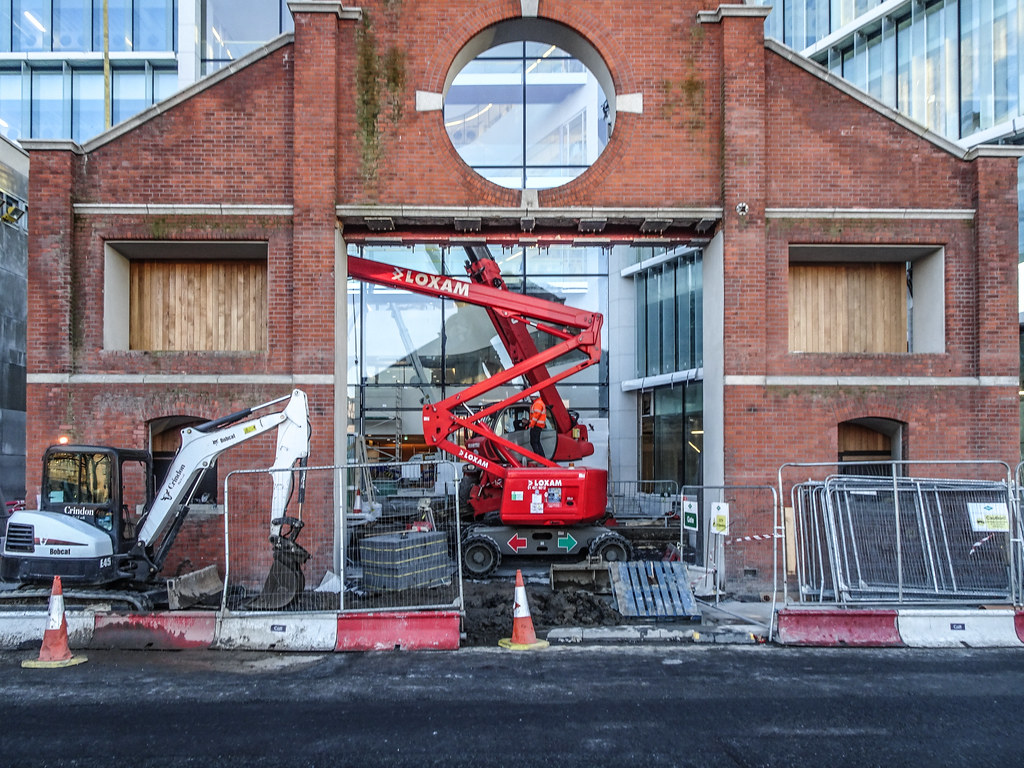
Bellwater has spent years selling Foundry Row's transformation from shuttered factories to biotech offices as an unambiguous success. Now the neighborhood may be a victim of that success: it is running out of the specialized lab space its biotech tenants need to keep growing.
Wet-lab space, the specialized commercial real estate configured with the plumbing, ventilation and safety infrastructure biotech research requires, has become the tightest segment of Foundry Row’s commercial market, according to figures from a regional commercial real estate firm that tracks the neighborhood. Vacancy for that category of space has fallen from roughly 11 percent five years ago to under 4 percent currently, even as overall Foundry Row office vacancy has held closer to 9 percent.
A shortage built into the buildings themselves
The shortage stems partly from the limited number of Foundry Row buildings that have been retrofitted with wet-lab infrastructure, a conversion process property developers say costs significantly more per square foot than standard office build-outs. Only a handful of the neighborhood’s converted factory buildings currently offer the specialized plumbing and ventilation systems biotech tenants require, and developers have been slow to retrofit additional buildings given the higher upfront cost and uncertainty about long-term biotech demand.
Kestrel Biologics Chief Executive Elena Marchetti, whose company has previously discussed plans to nearly double its Bellwater workforce and is scouting sites for a planned second facility, said the lab space shortage has already narrowed her company’s options. “We assumed a year ago that finding our second facility within Foundry Row would be straightforward,” Marchetti said. “It has not been. We’re now seriously looking at sites outside the neighborhood, and possibly outside Bellwater entirely, which is not where I wanted this conversation to go.”
We assumed a year ago that finding our second facility within Foundry Row would be straightforward. It has not been.
Elena Marchetti, CEO, Kestrel Biologics
Rising rents on top of a shrinking pool
The shortage has driven wet-lab rents up sharply, according to the commercial real estate figures, with average asking rents rising roughly 40 percent over the past three years even as the broader Foundry Row office market has seen more modest increases. Theresa Nakamura, executive director of the Bellwater Chamber of Commerce, said she has heard growing frustration from biotech employers at her office’s quarterly meetings between Foundry Row companies and workforce-training providers, where lab space has increasingly displaced hiring as the top complaint.
“For years the conversation at those meetings was entirely about finding trained workers,” Nakamura said. “In the last two meetings, at least half the conversation was about whether these companies can even find a building to put those workers in.” Council Member Luis Bettencourt, who represents Foundry Row, said he has asked city planning staff to study whether zoning changes could encourage developers to retrofit additional buildings for wet-lab use, though he acknowledged any such change would take years to produce new available space.
Not everyone views the shortage as an unambiguous problem for the city to solve. Denise Okonkwo-Marsh, lead organizer of the Lowertown Tenant Alliance, said she has limited sympathy for biotech companies frustrated by rising real estate costs in a neighborhood where the same market forces have pushed housing further out of reach for longtime residents. “These companies benefited enormously from cheap Foundry Row real estate when they were starting out,” Okonkwo-Marsh said. “Now the market’s tightened up on them the same way it’s tightened up on everybody else, and I’m not going to pretend that’s a tragedy.”
Ridgeline Therapeutics, Kestrel’s chief local competitor for lab talent, has similarly reported difficulty finding expansion space, according to a company spokesperson who said Ridgeline has begun exploring a satellite facility in a neighboring county as a contingency. The spokesperson said the company still prefers to keep its footprint concentrated in Foundry Row given its proximity to Kincaid University’s research pipeline, but that the lab space shortage has made that preference more expensive to maintain.
- Wet-lab vacancy has fallen from roughly 11 percent to under 4 percent in five years
- Average wet-lab asking rents up roughly 40 percent over three years
- Kestrel Biologics is now considering sites outside Bellwater for its second facility
- City planning staff studying zoning changes to encourage lab retrofits
Marchetti said she remains hopeful the city can find a way to encourage new lab-space development before her company is forced to make a final decision on its second facility, a choice she said would come within the next year. “I’d genuinely prefer to keep growing here,” Marchetti said. “But I also run a company, and at some point the math has to work, whether the building we end up in is three miles from here or three hundred.”
Bettencourt said the council’s planning study will also examine whether the city could offer tax incentives to developers who retrofit existing Foundry Row buildings for wet-lab use rather than pursuing new construction, an approach he said could add usable lab space more quickly than ground-up development given the neighborhood’s limited remaining vacant parcels. He said he expects a preliminary recommendation from planning staff within the next several months, though any incentive program would still require a full council vote before developers could apply.