
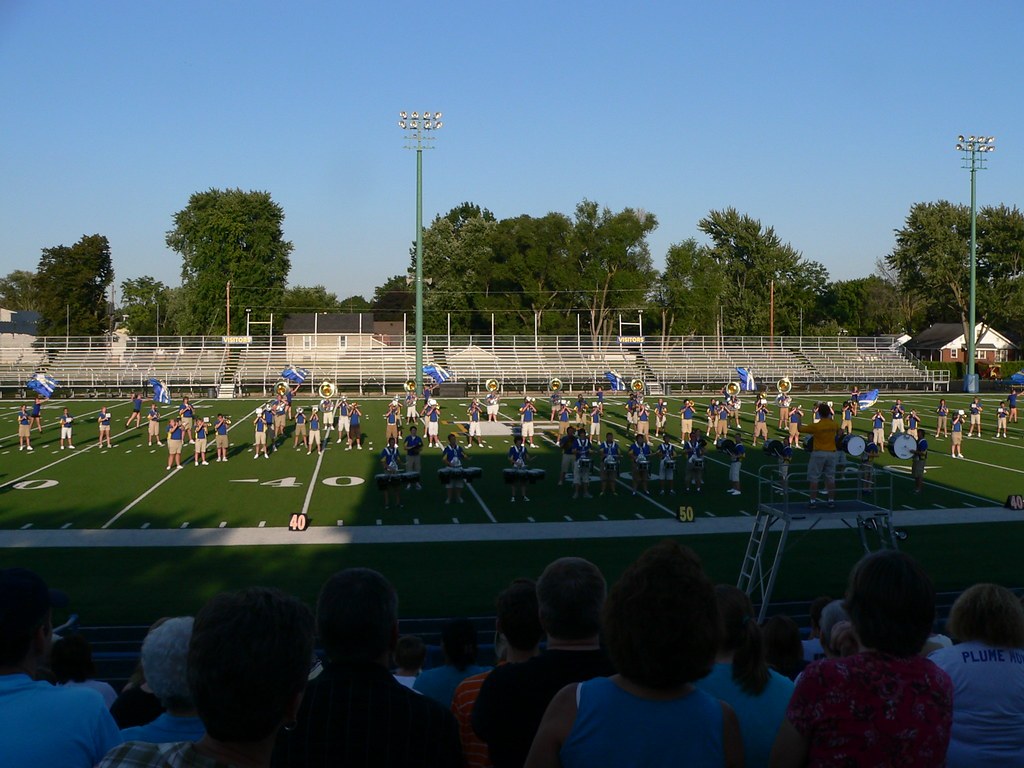
Metro Bellwater's high school football season begins this week with five programs at very different points in their arcs, from a Cedar Hollow team riding a turnaround to a Lowertown squad still rebuilding from the ground up.
The five programs enter the season with widely varying expectations, shaped as much by roster depth and facility resources as by what happened on the field last year. Here is a team-by-team look at what to expect from each as the season opens.
- West Bellwater High (9-2 last season, lost in the semifinals): The suburban program returns the most talent of any team in the metro area and enters as the preseason favorite. Coach Sonia Marek said the roster’s depth, built partly on strong youth-league feeder programs in the surrounding neighborhoods, gives West Bellwater the fewest questions of any team in the field.
- Cedar Hollow High (8-3 last season, reached the quarterfinals): After years of losing seasons, Cedar Hollow enters as a legitimate contender for the first time in nearly a decade under fourth-year coach Reggie Thornton, who has rebuilt the program around a physical run game and a roster almost entirely composed of neighborhood kids who came up through the same youth league together.
- Bellwater Central High (6-4 last season): The citywide magnet school, which draws students from across all six council districts rather than a single neighborhood, returns a experienced group under coach Wyatt Osman but lost its top rusher to graduation.
- Riverside Heights High (5-5 last season): Coach Pat Yarrow’s team is the metro area’s most difficult to project, having split its games nearly evenly against both the field’s strongest and weakest opponents last season.
- Lowertown High (2-8 last season): New coach Andre Boykins inherits a program that dressed as few as 19 players for some games last season, a roster shortage he attributes partly to economic pressures on families in the neighborhood rather than a lack of interest in the sport.
A gap that shows up in more than the win column
Boykins, hired over the summer after Lowertown’s previous coach resigned, said the program’s struggles go beyond scheme or talent. “I’ve got kids who want to play but can’t make every practice because they’re working a shift after school to help their family,” Boykins said. “You can’t scheme around that. You just have to build a program flexible enough to still develop a kid who missed half of August workouts for reasons that have nothing to do with football.” He said the school’s booster club has struggled in recent years to match the fundraising totals of programs in wealthier parts of the metro area, limiting equipment upgrades and coaching stipends for assistant coaches.
Marek, whose West Bellwater program benefits from one of the metro area’s most active booster clubs, said she is sympathetic to the resource gap even as her own team benefits from the disparity. “We’re lucky, and I don’t think it’s controversial to say that out loud,” Marek said. “Our booster club raised enough last year to fund a second athletic trainer at every home game. I’d guess some other programs in this preview don’t have one at every game, period.”
People ask me why Cedar Hollow suddenly got good. It’s not sudden. It’s four years of the same kids staying in the same program instead of transferring out the first time we had a losing season, and a neighborhood that decided this team was worth showing up for.
Reggie Thornton, Head Coach, Cedar Hollow High
Two contenders, three programs building
Most coaches and administrators around the metro area expect the season to come down to West Bellwater and Cedar Hollow, a pairing that would have seemed unlikely three years ago given Cedar Hollow’s recent history. Osman, at Bellwater Central, said his program’s citywide draw gives it a different kind of resilience than neighborhood-based schools, since it is less exposed to any single district’s economic swings. “We pull from every part of this city, which means we’re never entirely at the mercy of one neighborhood’s fortunes,” Osman said. “That’s an advantage some years and a disadvantage others, honestly, because we don’t have the same tight-knit feeder system a place like Cedar Hollow has built.”
Yarrow, at Riverside Heights, said his team’s mixed-income enrollment produces a roster that is harder to characterize than either West Bellwater’s or Lowertown’s. “We’ve got kids from some of the nicer streets along the river and kids from blocks a lot closer to what Lowertown deals with,” Yarrow said. “Some years that mix works in our favor and some years it doesn’t, and I honestly couldn’t tell you yet which kind of year this is going to be.” All five teams open conference play this week, with Cedar Hollow hosting Bellwater Central in the week’s marquee matchup.
Thornton said he has taken calls this preseason from coaches and administrators at other schools, including some outside the metro area, asking how Cedar Hollow rebuilt its youth-league pipeline after years of losing talented players to transfers. “I don’t mind sharing what worked for us, because honestly a stronger league across the whole metro area makes every one of these programs better,” Thornton said. “But some of what we did isn’t really transferable. It’s just showing up consistently for four years in a neighborhood that needed to see that commitment before it trusted the program again.”
Boykins said he has had similar conversations with Thornton privately, describing Cedar Hollow’s turnaround as the clearest evidence he has that Lowertown’s rebuild is possible on a similar timeline, even if the two neighborhoods face different specific obstacles. “Reggie was honest with me that it took him three or four years, not one,” Boykins said. “I’d rather hear that truth going in than promise our booster club and our players a turnaround by next season and then come up short. This is a multi-year project, and I’m trying to build it the right way from the start rather than chase a quick fix.”